Showing posts with label Creation. Show all posts

Friday

10 To The 44th Power... Really? You're Serious?


Just the other day I was reading an article on new theories of how DNA came into existence and one of the scientists wrote, “that there is a one in 1044 chance that the triplets occur at binding sites by pure chance.” He was discussing one essential part of his theory and used this number to support his theory. But keep in mind that he was dealing with only one detail in the whole process of DNA coming into existence. The probabilities in atheistic evolution have to all be based on chance.

What always catches my eye when the atheistic evolutionists speak of probabilities are the large numbers, in this case 1044. Don't just read over numbers like that. That is a huge number. So big I can’t find a name for it. It is a 1 with 44 zeros after it. 109 is 1 Billion.

How big is this number? Well lets see, the world population is estimated 6,898,075,483. If you bought a lottery ticket for $1, along with every other person on a million billion more planets with equal populations, your chance of winning the lottery would be far greater than the chances this scientist gave of just one part of his theory happening by chance. But that’s really not accurate, because in a lottery there is a sure winner, but in probability this is considered impossible. I’ll stick with God.


Naked, Living Underground, And Feeling No Pain


This is one strange little hairless creature. It is an African rodent commonly called the Naked Mole Rat. These rodents live almost exclusively underground in tunnel systems that can extend for up to three miles. Their uniqueness doesn’t end with just their looks.

One amazing thing about them is they are cancer free. Scientists believe this is because of a special gene called P16. But whatever the cause they are the longest living rodents in the world with life spans of over 20 years. The oldest on record was 28 years.

They live in colonies very similar to ant colonies. The average colony consists of around 80 rats. Each colony has one queen, and a few mating males. The rest of the colony population is made up of sterile workers, which gather food, and soldiers, which protect the colony from intruders. These, and another type of mole rat, are the only mammals to live this way.

Their lungs are small, but their bodies use oxygen very effectively. They can almost shut down their metabolism for long periods of time. They also can’t feel pain because of the lack of a neurotransmitter and they cannot regulate their body temperature like other mammals. The complexity and size of God's creation never ceases to amaze me.

Beautiful Meat Eating Water Plant


The flower of this plant is compared to Orchids and Snapdragons for beauty, but lurking under these beautiful flowers and stems in fresh water areas of the world is “one of the most sophisticated structures in the world.” The plant is commonly called a bladder-wort, its formal name is Utricularia, and it lives its life in the water.

The underwater structure is a trap, a hollow bladder. It is used by the plant to capture and digest living creatures. This plant bladder eats any living thing in the water including tadpoles, insects, and small fish fry. So how does it work?

The bladder is a precision instrument that uses pressure to bring prey into the bladder. When the bladder is full of water it pumps the water out through special cells designed to let water out but not let it back inside. As it pumps the water out the outer lining of the bladder is drawn in to create the resistance necessary to draw water, and unsuspecting prey, in through a trap door hinged by a special elastic material. Extending from the door bottom are hairs that work like doorknobs. When they are touched the door opens and the bladder expands to suck in water and whatever creature touched the hairs.

Here is another complex system which provides more evidence of design and therefore a designer.

Delayed Pregnancy


One of the most mysterious biological realities presented to modern scientists by over 100 species of mammals is delayed pregnancy. What this means is fertilization of an egg has taken place, but the mother can delay the implantation in the uterine wall by days, weeks, months, and in some cases over a year.

It seems some mother’s bodies automatically control this until their current litter has matured enough to be on their own, but with others there is something more complex at work. It seems these animals can calculate when it is safe or they are ready to be pregnant.

Some seem to delay pregnancy over concern about the environment. For instance an animal in an arid location, like some Kangaroos, can withhold pregnancy until there is abundant water. Others, like a bear, will wait until they have received enough food to support a safer pregnancy and delivery. Others wait until the weather is optimal. But all of these tend to watch for multiple factors to ensure a safe delivery. The biological system behind this amazing gift is what is unclear to scientists.

What is clear is that God designed these animals for optimal reproduction. This is another in a seemingly endless list of complexities that point to an amazing creator.

Bug With Bifocals

This is a bug, the Sunburst Diving Beetle, all southeast Texans could love. Its main diet is mosquito larvae. But scientist just recently found a first in the world: this bug has bifocals. That’s right: bifocals. Two lenses in each eye. That’s not four eyes, but two eyes with two lenses each. It also has two retinas in each eye.

Researchers are still working to find out just how this bifocal system works but they theorize that it is very similar to how humans use bifocals. One lens is for close up vision and the other is for distance. It seems the brain of the bug may shift the conscious focus from the blurred image to the more crisp image.

Scientists believe the effect of this could be similar to High Definition vision. It may deliver a precision in clarity of vision that is unrivaled in the world. They think the brain may actually use information from each image for HD clarity. Another amazing creation from an amazing Creator.

Tuesday

Killer Bird Helps Rebuild Australian Rainforest

A few years ago Carol and I were blessed to be the guests of an Australian church for 2 weeks, and then we spent a week alone for our 30th anniversary. We spent this special week in northern Queensland, Australia. This area has been devastated this week by Yasi, a Category 5 Hurricane, or Cyclone as they call them in the Southern Hemisphere. One of the most exciting events for me was our journey through the rain forests to historic Daintree, and then to Cape Tribulation.

One of the reasons for my excitement was the wildlife which ranges this area, and the unique plants that grow there. Huge crocodiles, tree kangaroos, flying foxes, beautiful flowers, mangroves, and rare exotic insects live in this rain-forest. The people are pretty interesting too.

Perhaps the most famous animal in the area is the Cassowary. The flightless Cassowary is one of a few birds in the world which can cause a human serious injury or death. The females grow up to 6 feet tall. They can run up to 30 miles an hour and jump over 4 feet high. They are very territorial and have injured human invaders on many occasions through the years. They have a dagger like middle toe on each foot which they use to viciously stab intruders. Some Aussies say they have poked holes in their vehicles with this stiletto toe.

After the devastation of Yasi it will be the Cassowary that will help rebuild the vegetation. In fact, the Australian rainforest must have the fruit eating Cassowary to survive. It is the only animal big enough to eat large fruit from over 60 plants and spread the seeds. The Cassowary is a vital part of a delicately balanced system put in place by our Creator.

Friday

The Most Accurate Spitters In The World

Spitting cobras are one of the most lethal snakes in the world. Their bite can inject a deadly neurotoxin into the victim's body. But when cornered, something you really don’t want to ever do, they can spit venom up to 6 feet with amazing precision and accuracy. Well... they don't actually spit, they spray venom. 

If the venom simply lands on your skin it will usually have little affect, but you should still quickly wipe it off while you’re running. If it lands on your skin the cobra has made a rare miss, because it never aims for the skin, it shoots for the eyes of its victim. When it hits the eyes the venom can cause permanent blindness in a matter of minutes.

The venom is projected from a small forward facing hole close to the tip of each of the snake's two fangs. The muscles controlling the release of the venom are responsible for producing the power necessary to shoot the venom.

Researchers have found that the snake tracks the eyes and movement of the head of its victim. The snake moves its head in the same directions and speed ratio of the victim's head, and just as the victim's head changes direction the snake will instantly move its head that direction and fire the poison where it expects the eyes to be in 200 milliseconds. Researchers have found the snake to be amazingly accurate.

How did the spitting cobra learn its venom will only affect the eyes? And... how could venom that will only affect the eyes evolve by chance? It either blinds or it doesn't. Again, here is a complex system that must have been designed. This amazing system includes the muscular structure, precision holes in the fangs, brain function to track the eyes of the victim and coordinate with the body, and special venom. There is a Creator.

Thursday

In The Eye Of The Octopus - An Evolutionary Nightmare

One of the most interesting creatures known, at least to me, is the octopus. Recent research has gleaned a wonderful amount of information about these highly intelligent sea-creatures. One of the most interesting is the eye.

Octopus eyes are the closest to human in the animal world. Both eyes have a retina, cornea, an iris, lens, and a fluid-filled interior. This presents a problem to chance-based evolution, since both eyes developed completely separate. Their supposed common evolutionary ancestor would have had no eyes.

The optical system, which includes the brain, is amazingly complex, and difficult enough to explain without a creator, but when two developed separately at the same time the mathematical probability of this happening by chance becomes outrageously low even with infinite time for it to happen. Limit the development to millions of years, as atheistic evolution must, and the chances are ludicrously close to zero. If there were a million points between 1% and 0 the chances of this happening would reside in the last point closest to zero on the zero side of that point. I'm not kidding. These are the probabilities firmly rooted in atheistic evolution.

This equation of optical probability must include the development of the system supporting the eye, including not just physical structure, but the probabilities of life itself. An equation including the probabilities of life must also include the probabilities of the existence of a planet capable of producing and sustaining life... and eyes. Atheistic evolutionists sometimes play shell games with non-contextual probabilities, this means they start the equation someplace within the already existing environment of the organ and/or use genetics to make the probabilities a bit more palatable, but the percentages are still amazingly low.

The complexity is further compounded by the Octopus eye, since it’s based on skin cells. The Human eye is basically a cellular extension of the brain. So each must have necessarily evolved on different cellular tracks. While still impossible, it is easier to explain the development of a nervous system based eye, than a skin based eye. The nervous system of the skin based creature would have to “find” the eye, and develop a brain that could “see” with the skin cells. There is not enough time available in the evolutionary time table for this to take place. All this from the eye of the octopus... God is amazing.

Friday

God's Winter Wonder - The Snowshoe Hare

The snowshoe Hare has many amazing biological systems necessary for survival in the cold northern regions of North America. It’s name comes from its feet. They are abnormally large and can spread out to make it easier to walk or run on snow. The bottoms of their feet are fur covered to help keep them warm. They also use their feet to thump the ground to warn of danger. When a thump is heard all Hares cease any movement while watching and listening for any threat.

When they run they can reach speeds of up to 30 miles an hour and change directions on a dime. They can also jump 10 feet from standing still. When they need to, they can swim faster than most non-water based mammals. The creatures were made for their environment.

The hare has a white coat in the winter, and a rusty brown or beige coat in the summer. It has separate hair follicles for each coat color which may be regulated by day length. I have not been able to find any explanation for how this takes place. It seems molting is still somewhat of a mystery. But we do know it is a complex system obviously tied to the environment.

Their ears are like sensitive microphones which can be turned in varying directions. The brain fully responds to each direction of sound and can locate the sound source with amazing precision.

These beautiful creatures are born fully covered in fur, eyes open, and ready to run. God is amazing.

Thursday

Blood Pressure - Can't Live Without It

The system that produces the pressure necessary to deliver blood to cells and then return the blood for re-oxygenation is one of the most complicated and vital systems on earth. Each individual human body has on average between 60,000 (96,000K) and 100,000 (160,000K) miles of blood vessels.

Blood pressure is the pressure exerted by the blood against the walls of the blood vessels, especially the arteries. This system is complex but basically has five parts. The first is the pressure sensory system. The body has sensors throughout the system which keep the brain constantly aware of the pressure. If the pressure is too low or high the body, under the brain’s direction, can adjust to change the pressure. These adjustments help us understand the other parts.

The pump or heart can speed up or increase its blood output to increase pressure. The opposite will decrease the pressure.

The walls of the blood vessels in a healthy person can dilate or contract. This change in resistance may decrease or increase the pressure on the walls. The length and size of blood vessels also affect the pressure of blood flow. The longer the vessel the higher the resistance, so the circulatory system is engineered for size and length to carry blood at a pressure below the level that would rupture vessel walls.

The brain can send more blood to the kidneys which will increase urine output. Urine is primarily water that is removed from the blood. When the kidneys make more urine the volume of blood decreases which can lower blood pressure. When we loose blood our brain can slow the blood flow to the kidneys to increase blood volume and, therefore, blood pressure.

I am told that salt has an effect on blood volume in some people. It tends to increase volume and may increase blood pressure. The kidneys can also regulate sodium retention in the blood.

The concentration of blood sugar may change the viscosity (thickness of fluid) of the blood. The more sugar (think of syrup) the thicker the blood.

How would life exist for long without all of the above at the same time? The human circulatory system is a marvel of creation engineering. Our Creator, the Chief Engineer, is amazing.

A Sea Animal That Lives Over 200 Years

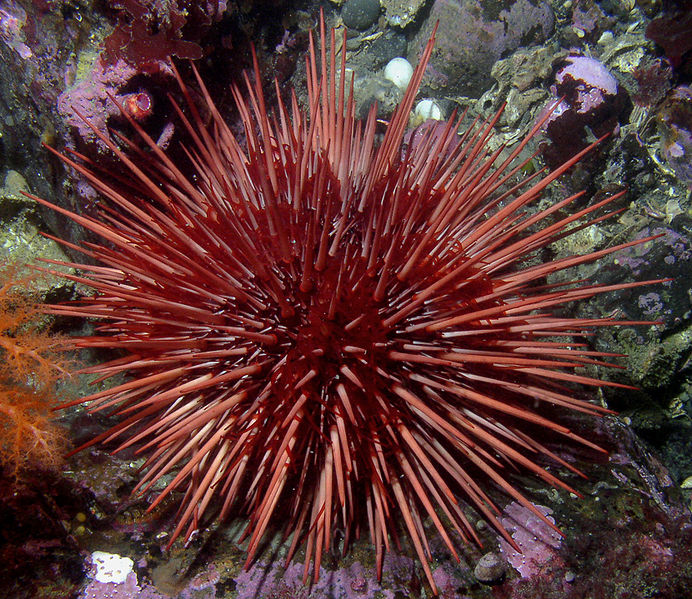
What can live over 200 years, doesn’t look a day past 20, has eyes in the back of its head, and spines all over its body? Tap, Tap, Tap, I’m waiting... Did you say a sea urchin? RIGHT! How’d you know?

Recent research on sea urchins has been nothing short of amazing. Scientists have discovered that urchins have light sensitive cells at the ends of the spines that cover their bodies. It seems the more spines an urchin has the more ability it has to “see”. This means that the nervous system of the sea urchin is also attached to the complex network of light sensitive cells. Scientists have yet to tell how well the urchins can see, but they do believe the creature can see well enough to discern what may be harmful to it.

Another amazing find is that the sea urchin can live beyond 200 years. A cool fact is they don’t know how far beyond 200 years one can live without any predators present. It also seems there is little difference between a 20 year old urchin and a 200 year old urchin. It seems there is no record of death from old age.

Could it be there is a creature on the earth that doesn’t deteriorate with age? Hard to imagine this could be the case. Can’t wait to see what future research unveils. Another complex creature in a world of amazing biological systems designed by a glorious creator.

These Frogs Freeze Solid And Live Through It

During winter in Alaska, the wood frog (Rana sylvatica) freezes so that it looks like a frog-shaped piece of ice. While frozen, the frog stops breathing, its heart stops beating, its blood stops flowing, and it cannot move. However, when spring arrives, the frog’s body thaws and the frog returns to normal life.

This is an amazing feat that would certainly be highly unlikely to have developed by chance. To restart the function of the frog’s systems after they have been frozen requires extremely complex genetic programming.

The adult wood frog grows to be only about 3 inches long. The frog lives in Canada and also in the United States from Alaska to Alabama. The wood frog is one of only three species of frogs that live north of the Arctic Circle.

Before the severe Alaskan winter arrives, the wood frog stores glucose in its liver. When the frog’s feet begin to freeze, its liver releases lots of glucose into its blood stream.7 Much of this glucose enters the frog’s cells and acts like antifreeze to prevent them from freezing.

During winter, 35–45% of the water in the frog’s body freezes. This makes the frog as stiff as a lump of ice! When the spring thaw arrives, the frog’s frozen body revives. Lawson Schroeder (adapted)

Lawson Schroeder pointed out this amazingly complex system. Complexity doesn't just happen, it comes by design.

Mosquitoes Can Sense Your Blood Type

Why do mosquitoes seem to hone in on some people and not others? Well in recent studies scientists have discovered that some proteins found in mosquitoes’ antennae connect with specific chemicals emitted from our skin. The chemicals are emitted as a natural process and mark our presence for the hungry little buzzing predators. But we don’t all give off the same chemicals.

People who have been ingesting alcohol, for instance, put off a special chemical compound which tells the little creatures there might be a person here who can’t swat as quickly as normal… get him… One 12 ounce beer will light you up for a mosquito like a neon sign.

The amount of carbon dioxide in the breath is also a serious marker. This is one of the reasons expecting women fall prey to mosquitoes more than most: they emit 21 percent more carbon dioxide than the rest of us. Their temperature is also an average 1.26 degrees higher than normal which is another “come and get me” sign to a mosquito.

We also emit certain chemicals that identify our blood type, and it has been found that mosquitoes can be picky when it comes to blood. Researchers tell us that people with Type O blood are bitten 24% more than people with any other blood type.

The mosquito is a complex creature with complex on-board equipment. This system includes the equipment to collect chemical data on the molecular level, a nervous system to convey the data, a brain with the ability to decipher the data and make it usable, and then the ability to act on the data and move toward the prey. A complex system like this didn't just happen, it was designed.

Thanksgiving Turkey Is Original Mexican Food


Yep... you read that right. Enjoy your original Mexican food on Thanksgiving. Turkeys only existed in North America and Mexico until the 1500s. Centuries before the first Europeans ever put a savory piece of Turkey in their mouths Mexicans had domesticated and raised Turkeys for meat. That's right, domesticated turkeys originally came from Mexico. The Spaniards brought domestic turkeys to Europe in the early 1500s. England got them about the same time, and then introduced them into the USA in Jamestown. So while the United States has its own wild turkeys our domestics came from Mexico through Spain and then England. So if you aren't eating wild Turkey tomorrow you are actually eating authentic Mexican food!

That's OK with me... I love Mexico, the Mexican people, and Mexican food, but please don't try to tell me that cornbread dressing came from anywhere but the southern United States, unless of course you would like to make a case for it being the manna from heaven that the Children Of Israel ate in the wilderness. I think there might be some merit to that notion!

But God did give the Turkey something special for the ole USA. The turkey’s head can change colors quickly. The three colors are red, white, and blue. When turkeys get excited their heads turn blue, when they become enraged some say they turn red while others say white. This phenomenon seems to be regulated by blood vessels and muscles moving the blood to or away from the surface. Perhaps that's why Ben Franklin thought the turkey should be our national bird.

A little more trivia. The reason these birds were called turkey is the first explorers thought the Americas were actually Asia. They thought this new bird was actually a cousin to a Turkish bird called a turkey. Strangely the Turkish bird lost the name turkey and the American non-Turkish bird kept the name.

New Research Has Disproved A Major Theory Which Supported Evolution

A theory that has topped the evolutionary pre-DNA theories, the Metabolism Theory, has been permanently debunked in a study released by a team of influential scientists and published in the Proceedings of National Academy of Sciences. One of the greatest problems atheistic evolution faces in the beginning of life is RNA or DNA replication. This is a problem mentioned by former atheist Antony Flew in There Is A God which helped lead him out of atheism.

Evolution requires that one of the first cells to exist must have been able to start a continual cycle of replication. Supporters of atheistic evolution hypothesize that there must be some connection or series of steps between that first cell and the non-biological substance from which it evolved. Until this study the foremost theory was the Metabolism theory which “allows for adaptation and evolution without any molecular replication.” There were also a number of other related theories that have now crumbled after this new research has come to light. These scientists proved that these “chemical networks” at the base of the Metabolism theory actually degrade instead of moving higher up the evolutionary tree. The report says at this time “no plausible chemical explanation exists for how these processes occurred.”

There must have been an agent to bring the biological structures of replication and reproduction into existence. There is no other plausible answer. Without an agent the first big problem is a pathway for a non-living substance to become a living substance by chance, but then the more complex problem is this new living substance must have had the biological structure to perpetually replicate itself. These two stand or fall together, because you cannot have one without the other and still have evolution. All the steps had to happen in perfect order the first time to bring non-living matter all the way to living replicating existence. The probability of this happening by chance is so infinitesimally close to 0 as to make the notion ludicrous.

Some say I shouldn't argue from the gaps in evolutionary theory... but this isn't a developmental gap in the process of evolution, it is a primary question upon which agency in evolution rests, and is a fundamental disagreement between deism and atheism. The numbers, logic, and revelation are on the side of deism. There is a Creator.

Big Numbers Leave Little To Chance

I am always amused when an atheistic evolutionist begins throwing around “billions” of years to support the contention that random mutation brought life to where it is today. I read the same numbers they read... and the probabilities just don't add up in their favor. The numbers are so big that they leave little to chance.

It's the big picture numbers that cause atheistic evolutionists so much difficulty. Let me explain. There are at least three big biological questions that have yet to be precisely answered. The estimated answers to these questions will help us see the Big Picture.
  1. How many living things are on the earth? Let me give you one writer’s answer: “There are 3 x 10 to the 33rd power (3,000 quintillion) individual living things on this planet.” Other estimates are equally astronomical. These are numbers we can’t get our minds around. Counting the living things on the earth is like counting the grains of sand on the earth or stars in the sky.
  2. How many species exist? The modern definition of a species is a “set of all individuals between which there can be gene flow.” Gene flow means an animal can mate, or could mate if functionally able, and not produce sterile offspring. The National Science Foundation Tree of Life project says there are 1.75 million identified species. NSF also says, “the 1.75 million known species are only 10 percent of the total species on earth.” That means there are potentially 17.5 million species on earth at this time. Another scientific estimate is that 99% of all species that have ever lived are extinct. This means there are estimates that 1.75 billion species have existed.
  3. There is one more issue that remains to be solved. How many unique and common biological systems exist? How many unique systems exist in individual species? If there is an average of 5 per species (and there are arguably many more that that) then the number of unique biological systems on this earth today is 87.5 million. Taking potentially all species in history this number could be as high as 8.75 billion unique systems.
Here’s the problem. Modern science estimates the earth is 7.5 billion years old. They say the earth was without life for the first 3.5 billion of those years. That leaves 4 billion years with developing life on earth. But for 3.5 billion of those years there was no life that could be seen with the naked eye. Modern evolutionary biology teaches that all life and modern species large enough to be seen with the human eye evolved over a 500 million year span.

This means the most complex systems went from non-existent to existent during a 500 million year period. 100 million of those years only produced invertebrate marine life. But let's just work with the 4 billion years figure. If we divide 4 billion by the estimated number of species that have lived on the earth, 1.75 billion, shear chance would have to produce 1 new species an average of every 2.2 years. If we just take the known species on earth today then it is 1 new species every 228 years. And we haven't even discussed the complexities of the evolution of species or the "Cambrian explosion". When we divide by the number of unique systems the range is 1 new biological system every 5 months to 45 years. That doesn't include the complex issues of the integration of systems within a species. The associated probabilities tied to these numbers are so close to 0 as to be almost non-existent. And... atheistic evolutionists know this.

It is numbers like these that helped convert the great atheist, Antony Flew, to deism. He said, “I believe that life and reproduction originate in a divine Source. Why do I believe this, given that I expounded and defended atheism for more than a half century? The short answer is this: this is the world picture, as I see it, that has emerged from modern science. Science spotlights three dimensions of nature that point to God. The first is the fact that nature obeys laws. The second is the dimension of life, of intelligently organized and purpose-driven beings, which arose from matter. The third is the very existence of nature.”

Atheistic evolution requires us to believe this all happened by chance… No… The numbers don't hold up... and they never have. I’ll take God. Considering the numbers I often wonder how many modern atheistic evolutionists are really closet deists.

Tuesday

The Burden Of Eternity

Matthew 25:46 And these shall go away into everlasting punishment: but the righteous into life eternal.

I still remember the period in my pre-teen years when I began mentally struggling with the physical and soulish concepts of eternity, a struggle that continued throughout my teen years. My turmoil over the physical side of eternity came with the realization that I will die.

What bothered me about this reality then is the same thing that bothers me now, this may sound a bit strange, but it was not the pain surrounding death that concerned me, it was the realization that the world would continue on... and I wouldn't be here to see it. 

One of the basic tenets of the brand of atheism I was exposed to was that matter is eternal, so I knew that the moment I breathed my last breath nothing in this material world would change... it would just continue on... and on... and on. (By eternal I mean without beginning or end. Orthodox Christianity teaches that matter had a beginning, but is now everlasting. A basic philosophical argument between deism and atheism is not what will be the state of matter, but what was the state of matter.)

This mental exercise over the physical reality of existence immediately led me to contemplate the unique nature of human existence in the cosmos. Are we just dust, or is there something non-physical about us that is as everlasting as matter? This led me to contemplate the existence of God and what He is if He exists. My conclusion, and one I still hold to today, was that there is a God, and this God must be a non-material transcendent intelligence, and the creator of all things including us.

This realization, for me, elevated conscious existence to a higher level than matter as the only knowable eternal substance. Could it be possible that I, not my body... but my being, might transcend matter and exist beyond death? I came to the conclusion that it was not only possible, but probable. This deepened my struggle.

I skimmed a book years ago by a man named Alexander. I remember almost nothing about the book except his comments about the burdens a spiritual person will carry through life. One of the heaviest burdens he said was the "burden of eternity." A spiritual person sees past this life… there is more than this… and this knowledge is the greatest burden of this existence. I felt this was a good expression of what had happened to me. The realizations that I mentioned above gave me this burden of eternity, and that weight has never left me.

It is a burden for self which manifests in the question: What will be the state of my being after this life? How can I know what the Creator has in store for me? I knew that the answer would not be found in the physical, it must be revealed mind to mind. And that revelation must be in harmony with what is visibly revealed in this created conscious existence: absolute law, justice, conscience and guilt, mercy that honors law and is, therefore, not capricious. This precise synthesis of revelation I found uniquely in Jesus and His Gospel.

But this realization of eternity also manifests itself as a burden for others... and the loving question that ever flows from that burden: “Where will you spend eternity?”

Thursday

Faster Than Its Shadow

A few years ago orthodox Jews in New York were horrified to find out that crustaceans were in the public water supply. Ingesting crustaceans is against Jewish law. Some non-Jews are probably a little bothered by it too. This new revelation gave birth to a new industry in copepod water filtering systems.

Copepods, small crustaceans, literally populate all the earth’s water systems. Some can be seen with the eye while others are microscopic. They are the major ingredient in zooplankton which is in all the world oceans and is the ecological base for sea dwelling animals.

Because of their minute size swimming in the ocean is like a human swimming in thick syrup. It would be difficult and exhausting for us, but even more difficult if we had to capture our food in the syrup. As we reached for lunch our movement through the syrup would push our food away from us. So how do blind ocean dwelling copepods get their food if moving toward it moves it away? Fast… really, really fast.

When a copepod senses food moving through the syrupy water within a few milliseconds it can accelerate to over 100 times its body length per second. For me that would be 620 feet per second in syrup. It can move so fast that the fluid viscosity around it changes, so their prey isn't pushed away and is easily captured.

Scientists are still studying copepods to gain more knowledge about how this happens. But we know that the system necessary to move this quickly in fluid takes streamlined bodies, raw muscle power, and an amazing nervous system to sense the prey and move directly to the target. Seems like this animal was designed to do this... if fact how could a blind copepod capture food and survive without a system like this? It couldn't...

God Walked In The Garden

I was standing in waist high grass when I took this shot
Genesis 3:8 And they heard the voice of the LORD God walking in the garden in the cool of the day:

I recently had the opportunity to spend a couple of weeks in a tropical rainforest that can receive up to 300 inches (25 feet) of rainfall a year. This and other factors make the forest explode with vegetation. A tropical rainforest is home to 1,000s of plants, insects, birds, and other animals. The flowers and fragrances can be amazing.

I realize the method for watering the pre-flood earth was different from today, but all the species, plus thousands of extinct species, grew on the earth and, I expect, in the garden. But this creation without physical controls, enforced limits, and oversight can become virtually uninhabitable to humans. Just getting to the beauty in an overgrown rain-forest is tough.
Some tropical trees are measured by the acreage they cover
Many tropical rainforests are overwhelmed by tall, large trees, which means the ground is wet, covered by roots, saplings, plants, vines, debris, insects, seeds, and it is always dark. Open areas are soon taken over by vines, bushes, grasses, and bamboo (which is in the grass family and can grow up to a few feet per day) making human travel very difficult. I walked for at least a mile in matted, tangled, waist to chest deep grass and each of my steps was cradled by the tangled grass at least a foot off the ground. It was similar to walking in deep snow.
Rainforest Bamboo
It is clear in this passage that God chose to physically enjoy His creation, but He required a special creature to enhance its beauty and productivity. This creature needed to have the senses to experience the beauty and value of this garden, and understand what it was experiencing. It needed to have the intelligence to recognize beauty and productivity derived from orderliness. The creature also had to have the functional ability to maintain a complex, fast growing garden so this beauty and fruit could be enjoyed and used.
Man was God’s solution. He created him with the senses to see, touch, smell, taste, and hear the garden. He gave him the intellect to appreciate the information his senses deliver. He was given the intellectual ability to understand change and its effects on his environment, and to plan these changes. He was given the physical ability to execute the plan, and then assess the result. Humans were not created to simply survive and reproduce. Mankind was created to make a beautiful, bountiful creation more fruitful by giving it order and making it accessible.
Accessible, it seems, primarily to God… God used man to maintain His garden for His own pleasure. He walked in the garden. I wonder if He still walks earth’s gardens?

Bite Once, Don't Let Go, Bite Twice. Can't Do It? This Animal Can.

How can an animal bite it’s prey once and then, without letting go, bite twice? The Moray Eel has a second set of jaws and can bite twice without letting go once.

This second set of jaws (pharyngeal jaws) rests in the throat of the eel waiting for the first bite by the Moray. Milliseconds after the Moray grabs its prey with its primary jaws this second jaw can expand to the width and height of the mouth chamber and extend out of the throat of the eel to bite the prey. Then with powerful muscle action the prey is pulled into the throat and digestive tract by this secondary jaw.

Most fish depend on powerful suction to bring prey into their mouths and digestive tracts. But the eel doesn’t have this ability so God gave it this survival method.

The complexity of this system is absolutely amazing. There must be a unique bone, cartilage, and tooth structure. There must be a powerful set of muscles to extend the jaw into the mouth, open/close the jaw, and then retract the prey into the throat. The nervous system must also be involved to control the whole process.

Every time there is a unique system introduced to science the mathematical possibility of atheistic evolution is decreased dramatically. Nothing is here by chance.

LinkWithin

Related Posts with Thumbnails